
Coming from a coffee growing region and family, I have experienced first-hand the benefits that come from coffee farming in my family and our community. With the supplementary income they made selling their coffee to local and international markets, my parents were able to educate myself and my siblings all the way through to college. Globally, coffee is an important cash crop providing a livelihood to approximately 100 million smallholder farmers. In recent years, however, many smallholder farmers in Kenya have abandoned the crop, cutting down trees and converting their land into real estate. There has been very little incentive for smallholder coffee farmers to invest in their farms due to fluctuating market prices, effects of climate change and deforestation, decreased ecosystem services and an upsurge of crop pests and diseases.
While studying Agriculture, I learnt about the International Centre of Insect Physiology and Ecology (icipe), where my love for basic science would be fulfilled. At icipe, using advanced equipment, I learned to study chemical molecules that influence insect behaviour and that can be manipulated to our advantage. A specific threat to coffee crop cultivation in Kenya is the infestation of the Antestia bug, a pest native to Africa. This pest poses a serious risk to smallholder farmers’ household incomes, causing crop losses estimated at 45% of total yield and the “potato taste defect” characterized by coffee with a bad taste and smell, which ruins the coffee for the international market.
Currently, Antestia bugs are mostly controlled by pesticides which have many limitations such as their high expense, toxicity to pollinators and acting as a health hazard to humans. Alternative pest control methods such as semiochemicals are therefore much needed. Semiochemicals are behaviour-modifying chemicals derived from living organisms such as plants, insects and microbes. They are preferred in pest management over pesticides because they are naturally occurring, target specific, nontoxic and are effective in small amounts. The goal of my PhD project is to identify semiochemicals that Antestia bugs use for host finding and aggregation and investigate how they could be used in surveillance and mass trapping or repellence of the pest in coffee plantations.
With this research, I hope to provide coffee farmers with an effective control strategy for Antestia bug pests that is cheap and environmentally friendly. Ultimately this will work towards benefiting farmers, human health, and Kenyan society.
Two peer reviewed scientific papers that have come out of some aspects of my PhD work can be found in the following links; https://link.springer.com/article/10.1007/s00049-017-0248-y & https://link.springer.com/article/10.1007/s00049-018-0259-3
ABOUT THE AUTHOR
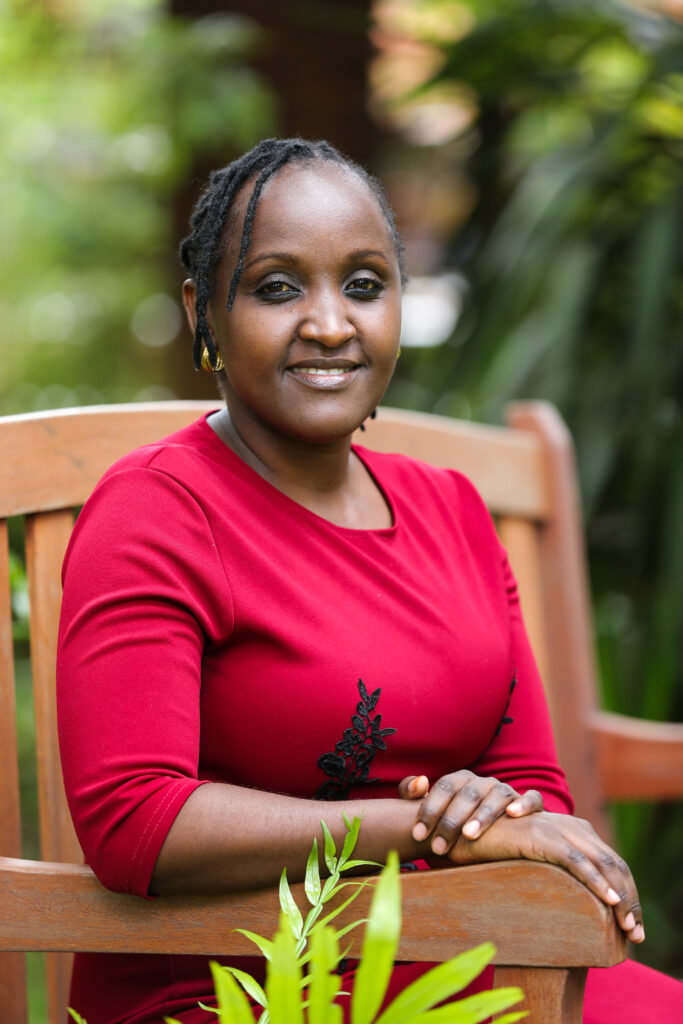
Teresiah Nyambura Njihia is a PhD Student at icipe, enrolled at Jomo Kenyatta University of Agriculture and Technology’s Horticulture department. Her research title is “Field evaluation of a trapping system for the control of Antestia bugs, Antestiopsis thunbergii in coffee plantations.” Besides research, she loves travelling to hike or camp with friends and family.